The Royal Park Bridge runs a little over half a mile from West Palm Beach to the Town of Palm Beach. Brokerage figures for late 2025 put single-family sales on the island at roughly three thousand dollars a square foot. On the mainland side of the same water the figure sat closer to six hundred. The drive takes two minutes.
Nothing separating the two ends of that bridge is a matter of weather or airport access. What separates them is what each municipality permits, how much of it has already been built, and how close a parcel sits to the Atlantic. Eric McNeil works the full run of coast from Miami through Boca Raton to Palm Beach, and the argument for covering all of it rather than one piece of it is that those variables produce a price map with very little relationship to the seventy miles of road connecting the ends.
Four governments, four incompatible answers to the same question
Supply in South Florida is not set by demand. It is set by codes written at different times, by councils with different intentions, and the gaps between them explain most of what happens to price.
Miami has been governed since May 2010 by Miami 21, a form-based code sorting the city into transect zones from T3, the low-density residential end, to T6, whose sub-designations carry a number indicating permitted storeys. Its most consequential provision for anyone watching the skyline is the Special Area Plan. An applicant controlling more than nine abutting acres can apply to assign transect zones, thoroughfares and civic space across the whole assembly, subject to dedicating a share of the aggregated lot area to civic space and building the public improvements. Which is why the largest changes to Miami’s built form arrive as assemblies rather than as single towers.
Coconut Grove sits inside that same city and behaves nothing like it. The Grove’s conservation rules hold principal buildings in its T3 zones to two storeys and twenty-five feet to the eave, impose a thirty-foot front setback, cap lot coverage on both storeys, require a certified arborist’s tree survey with a demolition submittal, and require any newly created building site to be no smaller than the majority of sites within five hundred feet. A developer cannot assemble his way out of that. The canopy the Grove trades on is written into the zoning, which is what makes it durable.
Delray Beach caps buildings within 125 feet of the Atlantic Avenue right of way, between Swinton Avenue and the Intracoastal, at three storeys and 38 feet. Everywhere else in its Central Business District the limit is four storeys and 54 feet. One rule, two numbers, and the reason Atlantic Avenue still reads as a street rather than a corridor of towers. Buyers pay for that scale without knowing where it comes from.
Boca Raton’s downtown runs on a different instrument again. Ordinance 4035, the development order for a downtown development of regional impact covering roughly 344 acres, generally holds buildings to nine storeys or a hundred feet and allocates dwelling units across seven subareas out of a fixed total. Adding units in one subarea means transferring entitlement from another. Downtown Boca is rationed by ledger rather than by appetite.
The Town of Palm Beach is barely a development market at all. Its island runs about eighteen miles, is nowhere wider than three-quarters of a mile, and narrows in places to five hundred feet. Its Landmarks Preservation Commission, established in 1979, holds protection over more than three hundred properties, sites and vistas, and the town describes itself as essentially built out and unable to extend its boundaries. New supply there is not restricted so much as absent, and the market consists of existing houses and estate sites changing hands.
A sponsor can decide to add inventory to Edgewater. No sponsor can decide to add it to Palm Beach.
What a mile of salt water does to a number
The second variable is water, and it outranks every other feature a residence can have.
Florida’s Beach and Shore Preservation Act, in chapter 161 of the statutes, directs the Department of Environmental Protection to set a coastal construction control line county by county, marking the part of the beach and dune system subject to severe fluctuation in a hundred-year storm event. Building seaward of that line requires a state permit on top of local approval, and the review takes in siting, foundation design, excavation, dune vegetation and turtle nesting season. Oceanfront parcels are therefore the scarcest and slowest to bring through, before anyone has argued about the view.
The gradient inland is steep. Redfin put Boca Raton’s citywide median at $453 a square foot in June 2026. Condo Black Book’s first-quarter 2026 figures put the Miami Beach segment, which runs from South Beach through Surfside and Bal Harbour to Sunny Isles and takes in Fisher Island, at $1,178. Palm Beach island sits well above either. Latitude explains none of that. Frontage explains most of it, in a strict order: ocean, then navigable water with a usable dock, then a view without frontage, then everything west of the highway.
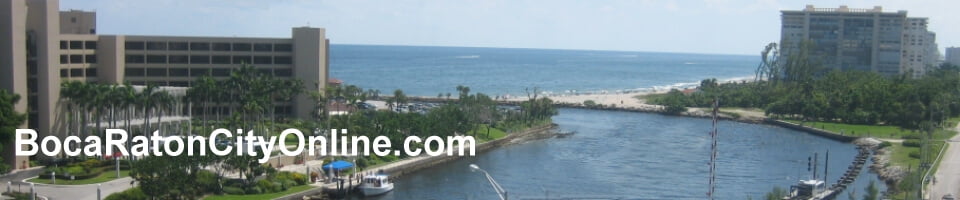
Boca Raton illustrates the point better than anywhere on the corridor because it contains both extremes. Its land runs west almost to the conservation areas at the edge of the Everglades, where the stock is gated, golf-oriented and comfortably priced. Its saltwater edge is a narrow strip between the Boca Raton Inlet and the county line. A house on a canal near the inlet with the bridge clearance to get a serious boat out is a different asset from a house three streets back with the same square footage and the same finishes. Jupiter works on the same logic with its own inlet, where clearance and depth decide what can be kept behind the house.

Two identical numbers describing opposite markets
The third variable is what is standing, and how much of it nobody has bought.
Condo Black Book’s first-quarter 2026 report recorded Brickell at a record high of $950 a square foot. Coconut Grove and Coral Gables together came in at $949. The two numbers are, for practical purposes, the same. The supply positions behind them were not. Greater Downtown Miami, the segment that holds Brickell, Downtown and Edgewater, carried roughly 41 months of condominium inventory. Coconut Grove and Coral Gables carried about 11. The publisher treats nine to twelve months as the balanced range.
One of those numbers describes a market where a buyer can take his time and set terms. The other describes a market where hesitation costs him the residence. A buyer reading price alone would conclude the two are interchangeable, and would make his most expensive mistake in week one.
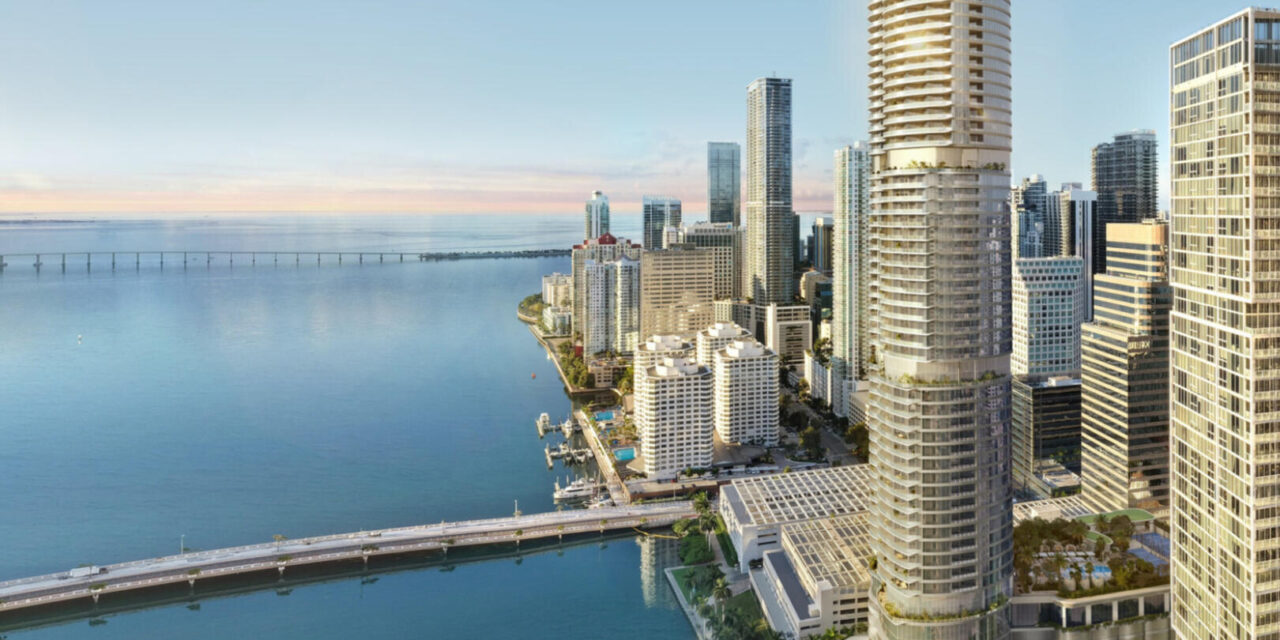
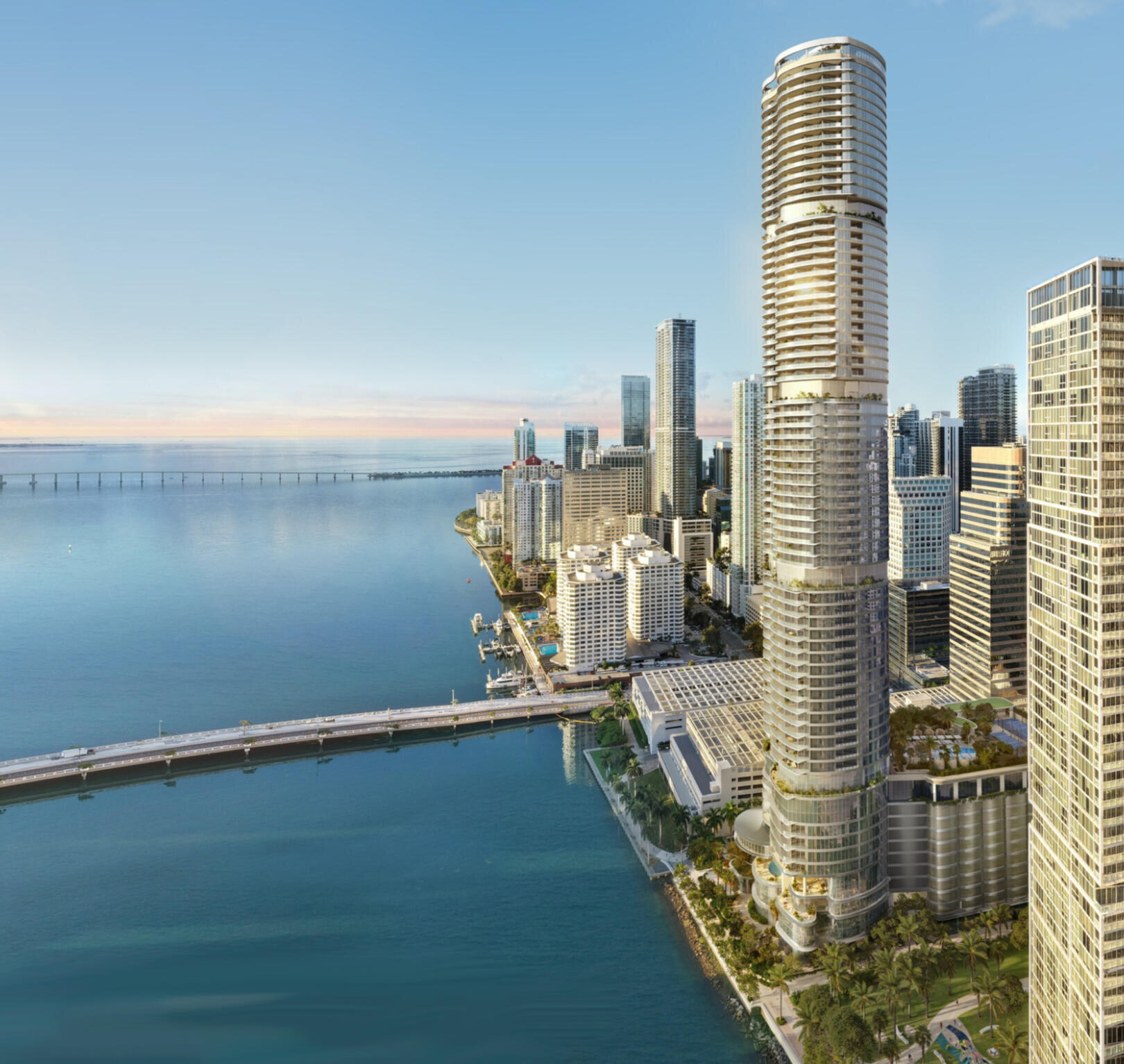
The buyer populations behind the stock differ as sharply. Brickell is vertical, dense and built around a working office district, and it draws professionals who want to walk to what they do. Edgewater sits on narrow bayfront parcels north of downtown, which is why its towers are slender and why so much of Miami’s new construction pipeline has landed there; its buyers skew younger and international. The Grove sells canopy and single-family stock that the conservation rules guarantee will not multiply.
North of the county line the buyer changes again. Boca Raton draws families and corporate relocations, and it has the employment base to hold them, including the 1.7 million square foot campus now called the Boca Raton Innovation Campus, described in trade reporting as Florida’s largest office complex and the site where IBM developed the personal computer. Delray sells a walkable low-rise downtown and the ocean strip behind it. Palm Beach sells estates and the resale of estates, to buyers who arrive with a specific street already in mind. Jupiter sells water and golf to people who use both.
Covering all of it means tracking multiple municipalities with different permitting environments, height restrictions, supply dynamics and approaches to new development. For McNeil, understanding those differences is central to evaluating luxury real estate opportunities across South Florida and building relationships with developers throughout the corridor. Rather than treating Miami, Boca Raton and Palm Beach as one market, his approach recognizes the distinct factors shaping development and opportunity in each.
This article is for informational purposes only. It is not an offer to sell or a solicitation of an offer to buy any security, and it is not investment, financial, legal or tax advice. Real estate and private market investments carry risk, including loss of principal, and nothing described here is a prediction of future results. Readers should consult their own licensed advisers before making any financial decision.

